






Gold Colloid
Setting the Gold Standard
BBI’s proven production process delivers citrate-capped gold nanospheres from 5–250 nm, with precise control over size and %CV for reliable, consistent results.
Reliable, lab-grade gold colloid and conjugates designed for research and diagnostics. Request your sample or custom solution today.
Fill out the form below for a quote or more information.
Brochure
Gold Conjugate Starter Protocol
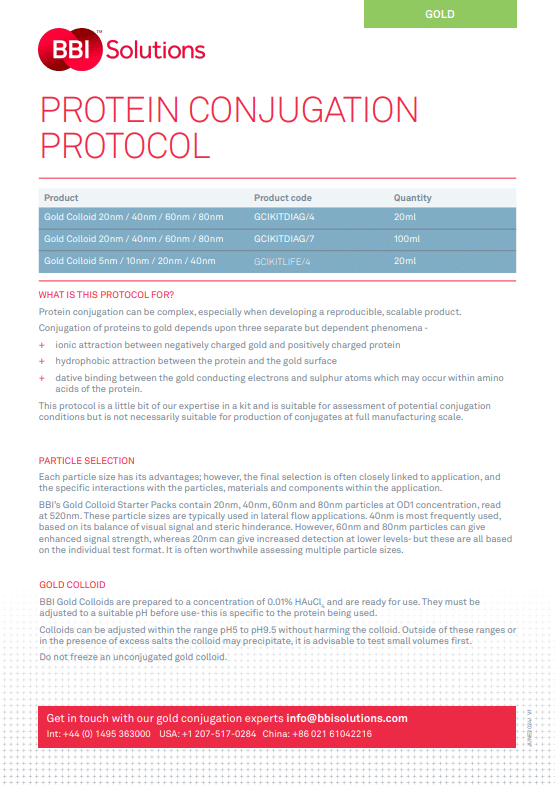
Protein conjugation can be complex, especially when developing a reproducible, scalable product.
Conjugation of proteins to gold depends upon three separate but dependent phenomena –
- Ionic attraction between negatively charged gold and positively charged protein
- Hydrophobic attraction between the protein and the gold surface
- Dative binding between the gold conducting electrons and sulphur atoms which may occur within amino
acids of the protein.
This protocol is a little bit of our expertise in a kit and is suitable for assessment of potential conjugation
conditions but is not necessarily suitable for production of conjugates at full manufacturing scale.
How long is a gold colloid stable for?
The gold colloid will remain stable until at least the expiry date stated on the label if the colloid is kept unopened at the recommended storage temperature (2-8°C). BBI’s EM Grade gold colloids are assigned a 24-month expiry date from the date of manufacture. Stability was ascertained by real-time stability studies for the shelf life of the product.
How should the colloid be handled to maintain its stability?
For best results (to help avoid particle aggregation) you should avoid pipetting directly from the bottle. Instead you should pour out a small aliquot into a suitable container
(borosilicate glass is recommended) and pipette from this. This protects the bulk solution from cross-contamination and potential introduction of particulate matter (such as dust) which can cause particle aggregation. It is recommended that the bulk volume of gold colloid be kept in its original container.
What are the largest and smallest gold nanoparticles that BBI can make?
The smallest gold nanoparticle that BBI offers is 5nm in diameter and the largest is 250nm. The particle sizes available are: 5nm, 10nm, 15nm, 20nm, 30nm, 40nm, 50nm, 60nm 80nm, 100nm, 150nm 200nm and 250nm.
What buffer is the colloid supplied in?
The gold nanoparticles are provided suspended in purified water (as made), with only residual chemicals left from manufacture also present in solution.
What are the key features and benefits of BBI’s gold colloids?
- BBI particles are proven stable for at least 24 months and are supplied with a minimum of three month’s expiry. Stable particles ensure a settled testing regime, saving you time and wastage
- Uniform shape and standard size with a low coefficient of variation. This ensures even antibody loading giving reliable results in your assay.
- Manufacturing scale. Batch sizes of up to 350+ litres to ensure you have a continuous supply.
How are the antibodies attached to the gold nanoparticle surface?
The antibodies are passively conjugated to the gold nanoparticle surface (no covalent or linker chemistry is used). Protein binds to gold colloid through amino acid residues: charge attraction (lysine), hydrophobic attraction (tryptophan), and sulphur bonding (cysteine).
What isotypes (classes) of antibody can be conjugated to gold nanoparticles?
IgG is the most popular isotype for conjugation and can be conjugated with a high success rate. The antibody binds to the gold nanoparticles through the Fc region, leaving the Fab region exposed and able to bind the antigen of interest. IgG3 antibodies are more difficult to work with so these should be avoided if possible.
IgM conjugations have a lower success rate. Cross-linking can occur when they are conjugated, and the Fc regions cannot always be exposed without damaging the integrity of the antibody.
IgE antibodies are raised in an allergic response, these antibodies can be conjugated to gold nanoparticles.
IgY antibodies are functionally similar to IgG antibodies and these can be conjugated to gold nanoparticles with a high success rate.
Antigen conjugations are possible, although the success rate is lower.
BBI can also conjugate other proteins, antibody fragments- Fab, Fc, ScFv and nanobodies.
What is the recommended storage temperature of the conjugates?
It is recommended to store the gold conjugates (BA Grade and Custom Conjugates) at 2-8°C. EM Grade conjugates can be kept frozen at -20°C for long term storage.
What do the various grades of conjugate (BA, CC, EM) available refer to?
BA refers to BioAssay. These conjugates are stock products which are routinely manufactured at BBI. These are most commonly used in lateral flow diagnostic tests. The particle size is 40nm.
CC refers to custom conjugates. These conjugates are similar to BA Grade conjugates but are usually manufactured on a custom basis by request of a customer. The particle size most commonly used is 40nm.
EM refers to Electron Microscopy. These conjugates are different to BA and CC conjugates, are usually made with smaller nanoparticles and are most often used in electron microscopy. The particle size most commonly used is 10nm.
EM refers to Electron Microscopy. These conjugates are different to BA and CC conjugates, are usually made with smaller nanoparticles and are most often used in electron microscopy. The particle size most commonly used is 10nm.
How dispersed are the conjugated gold nanoparticles?
Our gold nanoparticles have a high level of single particle dispersion.
40nm conjugates are tested using the MonoDispersity Index (MDI). MDI uses UV-Vis readings to assess the ratio achieved between the A520nm (absorbance at which 40nm OD readings are taken) and A600nm (associated with stability) of the conjugate. A pass/ fail criterion is assigned to the ratio which is deemed acceptable to produce a stable product.
Other gold nanoparticle sizes are assessed using Transmission Electron Microscope (TEM) to assess aggregation of the particles. This is a key indicator for the stability of the product.
Request a sample
Email us
info@Gold Colloid
Setting the Gold Standard for Nanoparticles
Every year our colloidal gold nanoparticles are used in over 500 million assays globally and are renowned for offering exceptional assay consistency levels. Our proprietary manufacturing technique allows for the production of large volume batches of gold to a high level of reproducibility of size, dispersion and shape, and we maintain this through tight quality control release specifications. This ensures a firm foundation for conjugation and peace of mind that your assay will provide reliable results.
BBI Solutions have been manufacturing high-quality gold nanoparticles for over 30 years, making us the trusted partner for thousands of researchers, lateral flow assay developers and manufacturers worldwide.

IN FOCUS
ISO Certifications
All our gold colloid and conjugates are manufactured at facilities certified to internationally recognised ISO13485 quality management standards – so your diagnostics start with a proven quality backbone.
Our ISO27001 certification ensures your data is safeguarded, and we’re now charting a path to ISO 14001 and ISO 45001 to fold sustainability and safety into every batch.